TLDR: We learn sparse, interpretable approximations of how reasoning fine-tuning changes MLP computation.
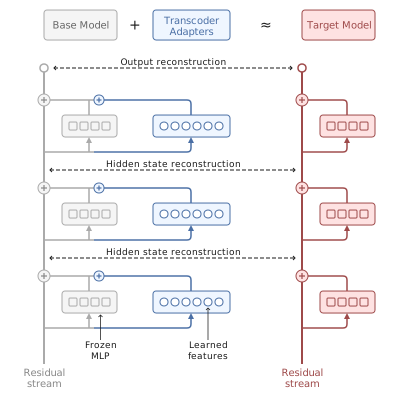
While reasoning models are increasingly ubiquitous, the effects of reasoning training on a model's internal mechanisms remain poorly understood. In this work, we introduce transcoder adapters, a technique for learning an interpretable approximation of the difference in MLP computation before and after fine-tuning. We apply transcoder adapters to characterize the differences between Qwen2.5-Math-7B and its reasoning-distilled variant, DeepSeek-R1-Distill-Qwen-7B. Learned adapters are faithful to the target model's internal computation and next-token predictions. When evaluated on reasoning benchmarks, adapters match the reasoning model's response lengths and typically recover 50–90% of the accuracy gains from reasoning fine-tuning. Adapter features are sparsely activating and interpretable. When examining adapter features, we find that only ~8% have activating examples directly related to reasoning behaviors. We deeply study one such behavior—the production of hesitation tokens (e.g., ‘wait’). Using attribution graphs, we trace hesitation to only ~2.4% of adapter features (5.6k total) performing one of two functions. These features are necessary and sufficient for producing hesitation tokens; removing them reduces response length, often without affecting accuracy. Overall, our results provide insight into reasoning training and suggest transcoder adapters may be useful for studying fine-tuning more broadly.
To enable interactive exploration of the interpretability results we report in our paper, we host feature and attribution graph data for our transcoder adapters.
@misc{hu2026transcoderadaptersreasoningmodeldiffing,
  title={Transcoder Adapters for Reasoning-Model Diffing},
  author={Nathan Hu and Jake Ward and Thomas Icard and Christopher Potts},
  year={2026},
  eprint={2602.20904},
  archivePrefix={arXiv},
  primaryClass={cs.LG},
  url={https://arxiv.org/abs/2602.20904},
}